Divine Retreat Centre UK – Official Website


Dewfall -22
October 15, 2026
How to overcome wrong relationships
November 7, 2026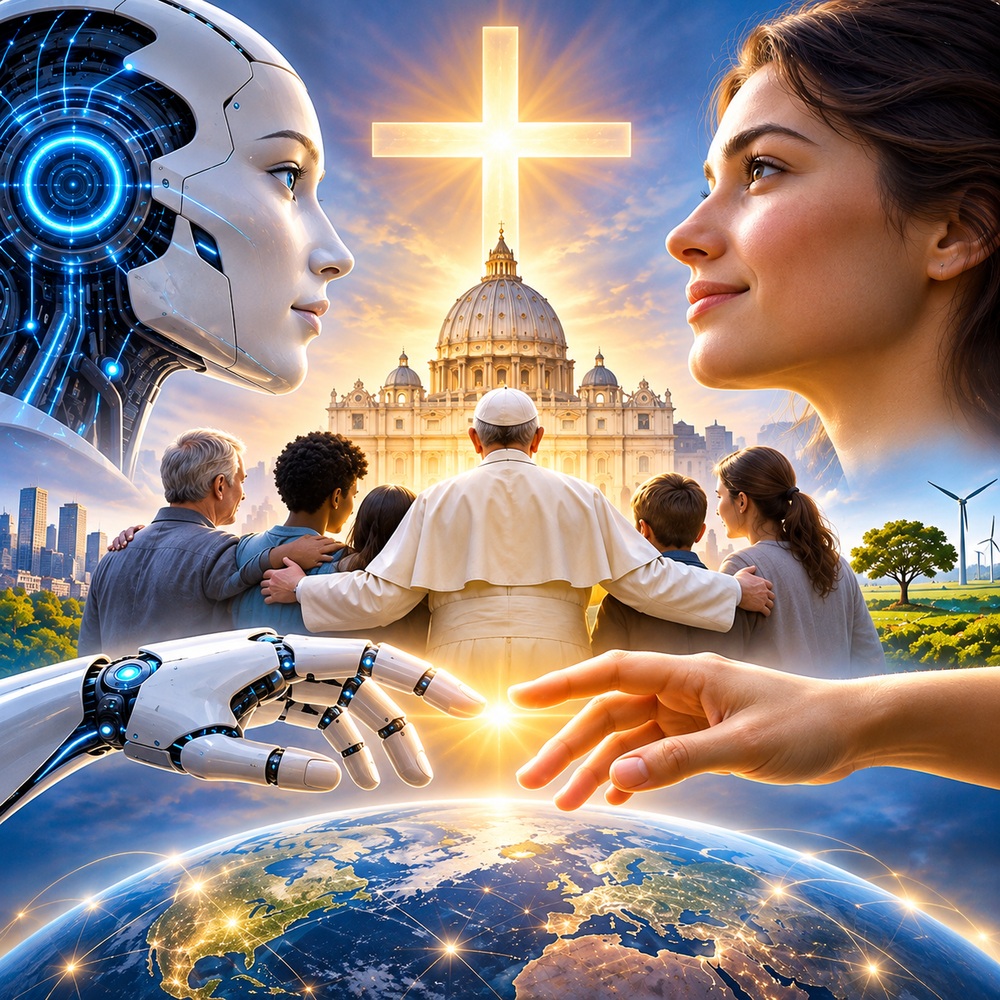
“The fear of the Lord is the beginning of wisdom.” (Proverbs 9:10)
Artificial Intelligence (AI) is changing the world at a remarkable pace. It helps us write documents, diagnose diseases, improve public services, and automate complex tasks. Yet as these technologies become more powerful, Catholics are called to ask not only what AI can do, but what it should do.
Technology is a gift arising from the human creativity that God has bestowed upon us. From the very beginning, God entrusted humanity with stewardship over creation:
“The Lord God took the man and put him in the garden of Eden to till it and keep it.” (Genesis 2:15)
Human intelligence reflects the image of God within us. The Catechism teaches: “Science and technology are precious resources when placed at the service of man and promote his integral development for the benefit of all.” (CCC 2293) The Church therefore welcomes scientific progress. AI can support healthcare, education, accessibility, and public services. Used wisely, it has the potential to reduce suffering and improve the quality of life for many people.
However, the Church also reminds us that technological progress must always serve human dignity. Every person is uniquely created by God: “So God created mankind in his own image.” (Genesis 1:27)
No machine, however sophisticated, possesses a human soul. AI can analyse data, but it cannot love. It can predict behaviour, but it cannot exercise conscience. It can generate words, but it cannot pray. Human beings remain infinitely more valuable than any technology because each person is created and loved by God.
The Catechism teaches: “The dignity of the human person is rooted in his creation in the image and likeness of God.” (CCC 1700)
This principle, therefore, must guide every discussion about AI. If technology undermines privacy, excludes vulnerable people, or treats individuals merely as data points, it fails to respect God-given human dignity.
Wisdom Before Innovation
Throughout Scripture we see that knowledge alone is not enough. Wisdom is needed to guide knowledge. “For what will it profit a man if he gains the whole world and forfeits his soul?” (Mark 8:36)
AI can help us become more efficient, but efficiency is not the highest Christian value. Compassion, justice, truth, mercy, and love are far more important. Pope Francis, during the G7 Summit on Artificial Intelligence on 14 June 2024, repeatedly warned that technology must never replace human relationships. Reflecting on AI, he taught that technological developments should contribute to the service of humanity and the protection of our common home rather than increase inequality and exclusion.
This echoes Christ’s commandment: “You shall love your neighbour as yourself.” (Matthew 22:39)
When creating, evaluating and using AI, we should ask:
- Does it respect human dignity?
- Does it promote the common good?
- Does it help the vulnerable?
- Does it encourage truth and justice?
- Does it strengthen, rather than weaken, human relationships?
The Warning from Pope Leo XIII
Although Pope Leo XIII ((1810-1903) lived long before computers, his social teaching remains remarkably relevant. In Rerum Novarum (1891), he warned against reducing human beings to mere instruments of production and defended the dignity of workers.
He wrote: “The employer must never look upon his workpeople as his bondsmen.”
As AI transforms workplaces, this teaching remains important. Organisations must ensure that technology serves people rather than treating employees as expendable resources. Human work is not merely economic activity; it is a participation in God’s creative work.
The dignity of work must remain central even as automation grows.
The Common Good in the Digital Age
Catholic social teaching stresses the importance of the common good.
The Catechism states: “The common good concerns the life of all.” (CCC 1905)
AI should not benefit only a privileged few. It should be used to improve society, especially helping those who are poor, elderly, isolated, disabled, or otherwise vulnerable.
Jesus identifies Himself with the most vulnerable: “Whatever you did for one of the least of these brothers and sisters of mine, you did for me.” (Matthew 25:40)
The measure of technological success should not simply be profit or efficiency, but whether it contributes to human flourishing.
Keeping Christ at the Centre
AI can answer questions, generate content, and process information, but it cannot replace faith, hope, and love. It cannot receive the sacraments, form a conscience, forgive sins, or experience the grace of God.
St Paul reminds us: “And now these three remain: faith, hope and love. But the greatest of these is love.” (1 Corinthians 13:13)
As Christians, we should embrace technological innovation with gratitude while exercising careful discernment. We must avoid both fear and blind enthusiasm.
The challenge before us is not simply to create smarter machines, but to remain wise disciples of Christ. As AI continues to evolve, may we remember that our ultimate value is not found in information, productivity, or technology, but in our identity as children of God. “Teach us to number our days aright, that we may gain wisdom of heart.” (Psalm 90:12)
Technology will continue to change. The Gospel never does. The enduring values of human dignity, compassion, justice, truth, and love should remain our guide in every age, including the age of Artificial Intelligence.
Article by Roseline Fernandes